

The short answer
The Hamsa is a hand-shaped amulet. The Evil Eye is an eye motif connected with beliefs about harmful envy or a hostile gaze. They are not the same symbol, although they are often used together because both have been associated with protection in Jewish, Middle Eastern, Mediterranean and North African traditions.
In jewelry, that means a hand-shaped pendant may be a Hamsa even if it contains no eye, while a blue eye charm may represent the Evil Eye without any hand shape. A design that places an eye inside the palm combines the two. Understanding this difference helps shoppers choose a symbol for its meaning rather than treating every protective amulet as interchangeable.
What is a Hamsa?
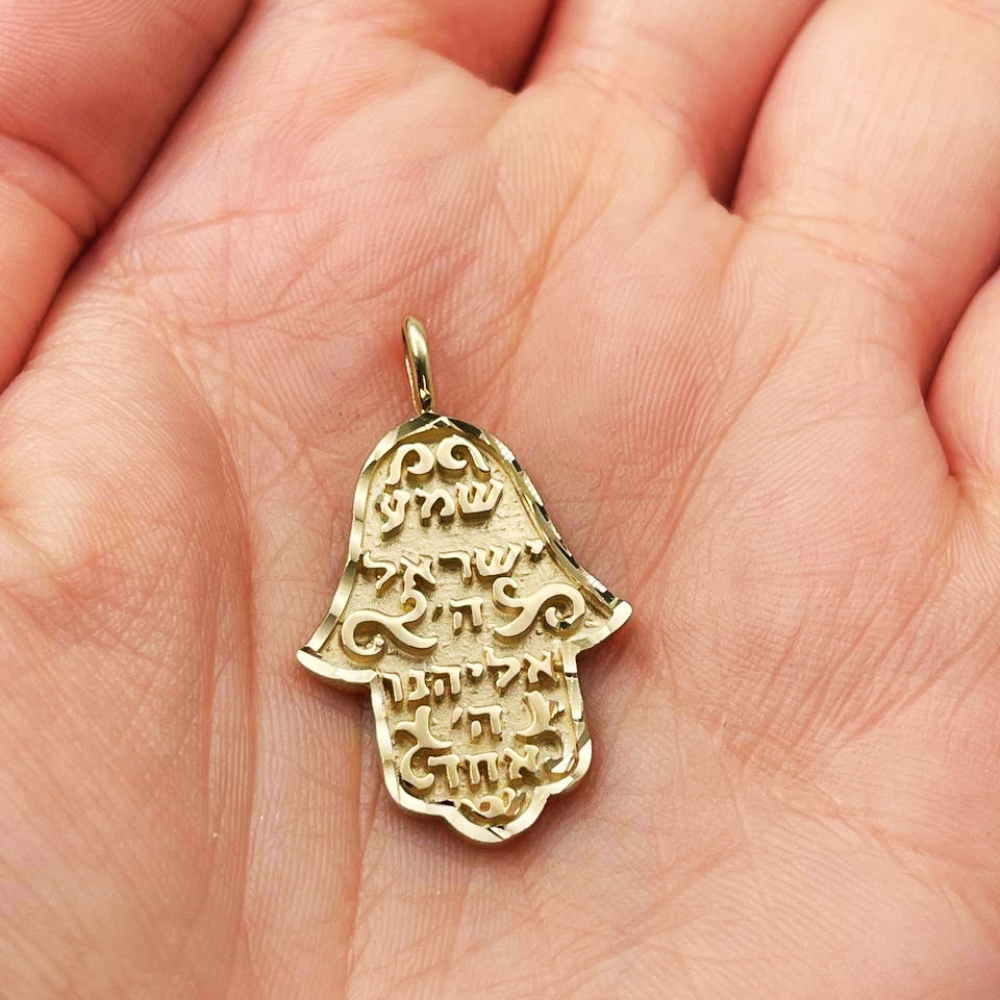
The Hamsa is typically shown as an open hand with five fingers. Some versions look like a natural right or left hand; others are perfectly symmetrical, with a second thumb replacing the little finger. In Jewish and Israeli contexts it is sometimes called the Hand of Miriam, though the symbol has a broader history and appears across multiple cultures and religions.
The word is commonly linked to the Arabic term for five. In modern Jewish art, Hamsas may include Hebrew blessings, fish, pomegranates, Stars of David, Jerusalem imagery, gemstones or an eye. The Hamsa jewelry category therefore covers much more than one standardized design.

What is the Evil Eye?
The Evil Eye refers to a very old belief that envy, ill will or a harmful gaze can bring misfortune. Variations of the belief appear in many cultures. Protective eye amulets developed as a visual response, and the familiar blue-and-white eye design is now common in jewelry, home decor and souvenirs across the Mediterranean and Middle East.
People may wear Evil Eye jewelry as a cultural symbol, a protective amulet, a reminder to avoid envy, or simply because they like the graphic form. A responsible description should avoid promising that a piece of jewelry will literally prevent harm. The meaning is traditional and symbolic, not a medical or factual guarantee.

Why the two symbols are often combined
The Hamsa and eye fit together visually: the broad palm creates a natural space for a central eye. Their meanings also overlap around protection, blessing and the desire to keep harmful influences at a distance. That is why a shopper searching for a Hamsa Evil Eye necklace will often see one pendant that contains both motifs.
Combining them does not erase their individual histories. The Hamsa remains the hand; the Evil Eye remains the eye. For content and product naming, that distinction is useful for SEO as well: a product that genuinely contains both symbols can be described with both phrases, while a plain hand should not be labeled as Evil Eye jewelry simply to capture a keyword.
Hamsa, Hand of Fatima and Hand of Miriam
Different communities use different names for hand-shaped amulets. "Hand of Fatima" is common in Islamic cultural contexts, while "Hand of Miriam" appears in Jewish contexts. Online searches for hand of fatima jewelry may therefore lead to visually similar pieces sold under different cultural descriptions.
For a Jewish jewelry store, the most transparent approach is to identify the design as a Hamsa and explain the cross-cultural naming in educational content rather than appropriating a story that does not fit the product. This helps international shoppers understand why the same basic hand motif appears under multiple names.
How to choose Hamsa jewelry
First decide whether you want the hand alone or a combined Hamsa-and-eye design. Then consider the overall style. A fine open-outline Hamsa can be delicate and modern; a filigree hand feels more traditional; a pendant filled with Hebrew text puts the religious language at the center; a gemstone or enamel piece adds color and becomes more decorative.
With necklaces, check the pendant dimensions and chain length. Baltinester currently has a deep Hamsa assortment, including many pendants and necklaces, so a dedicated Hamsa necklace landing page is a logical next step for shoppers who do not want to filter through rings and earrings. Until then, the main Hamsa collection should be the primary commercial destination.
How to choose Evil Eye jewelry
Evil Eye pieces are often smaller and more color-driven. Blue enamel, sapphire-like stones or glass are common, but the motif can also be rendered in diamonds or monochrome metal. Decide whether you want the eye to be obvious or integrated subtly into another symbol. Bracelets and small necklaces are popular because the motif works well at a compact scale.
If the piece is a gift, consider how the recipient understands the symbol. Some people see it as part of family or regional tradition; others wear it as a general good-luck motif. A short note explaining why you chose it can make the gift feel personal without making claims that go beyond the symbolic tradition.
Can you wear Hamsa and Evil Eye jewelry together?
Yes. There is no design rule requiring a person to choose one or the other, and many individual pieces combine both. If layering separate pieces, keep the composition visually controlled: vary chain lengths, repeat the same metal color, or let one pendant be the focal point while the other remains smaller.
The best reason to combine them is that the meanings resonate with the wearer, not simply because both are popular. Good Jewish jewelry content should help a buyer understand that story. That is also what makes symbol-based pages useful for GEO: they answer the question directly, acknowledge cultural nuance and then connect the reader to products that genuinely match the explanation.
Frequently Asked Questions
Is the Hamsa the same as the Evil Eye?
No. The Hamsa is the hand-shaped symbol; the Evil Eye is an eye motif. They are often combined in one design because both have protective associations.
Is the Hamsa a Jewish symbol?
It is used widely in Jewish and Israeli culture, but it is not exclusively Jewish. Its history crosses Jewish, Islamic, Middle Eastern and North African traditions.
Does Evil Eye jewelry guarantee protection?
No. Its protective meaning comes from cultural and symbolic traditions. Jewelry should not be described as guaranteeing physical, medical or financial outcomes.


