

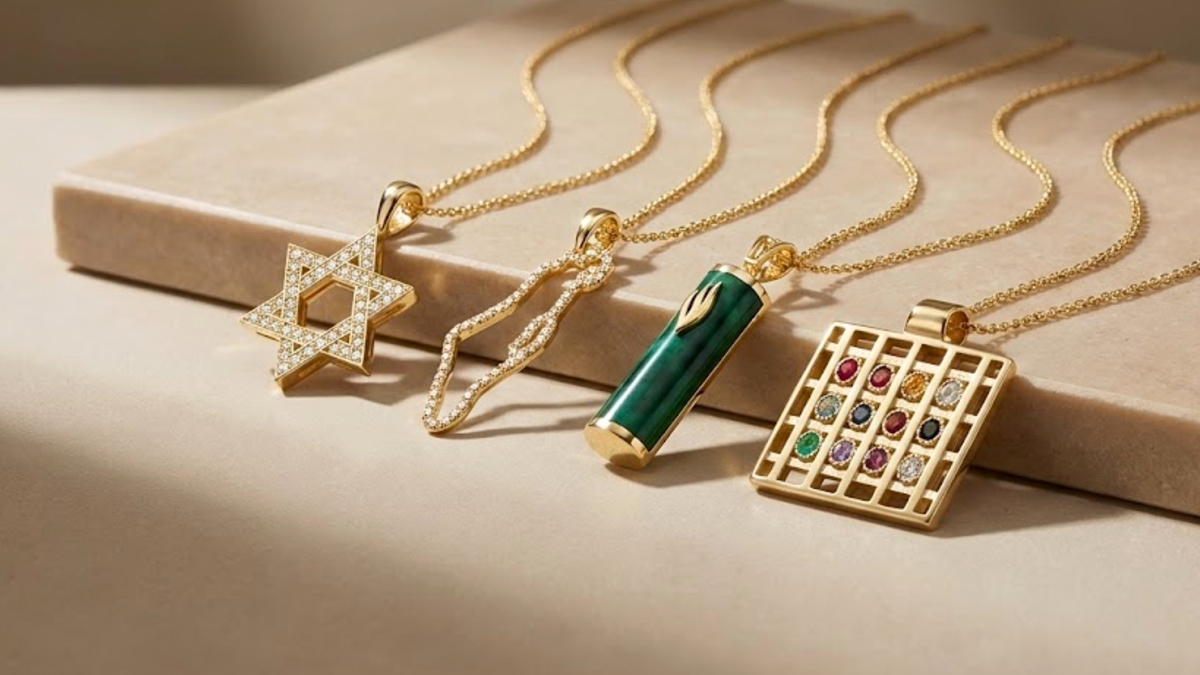
Why Jewish necklace symbols carry more than decoration
Jewish jewelry often works on two levels at once. A necklace can be visually simple - a small geometric star, two Hebrew letters, a hand-shaped amulet or a line of Hebrew text - while also carrying family history, religious language, cultural identity or a connection to Israel. That combination is why searches for Jewish necklace symbols are rarely only about fashion. People want to know what a symbol means before they wear it, give it as a gift or choose a design for a milestone.
There is no single rule for how every person understands these motifs. Some wear them as expressions of faith; others connect through heritage, memory, Israel, family tradition or simply a design that has become part of Jewish visual culture. The most useful way to choose a piece is therefore to understand the symbol first and then decide how prominently you want to wear it. The Jewish pendants collection brings many of these motifs together in gold, silver and mixed-metal interpretations.
Star of David: identity, community and connection
The Star of David, or Magen David, is the six-pointed star most immediately associated with Jewish identity today. It appears on the flag of Israel, on synagogues, on ceremonial objects and throughout modern Jewish art. In jewelry, it can be rendered as a fine open outline, a solid pendant, an engraved form, a diamond-set piece or a design combined with Hebrew text and Israeli motifs.
Because the symbol is recognizable at a glance, scale changes the message. A small Star of David necklace can be subtle enough for everyday layering, while a larger pendant becomes a deliberate statement of identity. For a gift, consider whether the recipient prefers classic geometry, contemporary minimalism, filigree, gemstones or a heavier masculine profile.

Chai: life and the number 18
Chai is the Hebrew word for life and is written with the letters chet and yud. In gematria, those letters have numerical values of 8 and 10, producing the number 18. That association explains the familiar Jewish custom of giving money or charitable gifts in multiples of 18. A Chai pendant therefore carries a concise, positive message: life, vitality and blessing.
Chai jewelry is especially versatile because the Hebrew lettering can be traditional, block-like, rounded, sculptural or integrated into another symbol. It works for men and women, for young people receiving a first meaningful piece of jewelry, and for adults marking a new stage in life. When comparing pieces, look closely at letter legibility, the weight of the pendant and the way the bail connects to the chain.

Hamsa and Evil Eye: protection motifs with overlapping histories
The Hamsa is a hand-shaped amulet found across Jewish, Middle Eastern and North African cultures. It is sometimes called the Hand of Miriam in Jewish contexts, while related traditions use other names. The design may be symmetrical or naturalistic and is often combined with an eye motif. In modern jewelry, the Hamsa commonly represents protection, blessing and good fortune.
The Evil Eye is related but not identical. The eye motif represents a long-standing belief found in many cultures that envy or a harmful gaze can bring misfortune; protective eye designs are worn as a symbolic response. Some pieces combine both motifs, which is why a shopper may see an eye inside a Hamsa necklace. Someone looking specifically for eye symbolism can compare the dedicated Evil Eye jewelry collection.

Shema, Hebrew inscriptions and words worn close to the heart
Jewish necklaces are also used to carry language rather than a purely graphic symbol. The Shema is among the best-known declarations in Jewish prayer, and designers frequently work with the opening Hebrew words in medallions, rings, plaques and pendants. Other pieces use blessings, personal names, verses or single Hebrew letters.
With Hebrew jewelry, accuracy matters as much as aesthetics. If a piece is personalized, confirm spelling before production and decide whether you want modern Hebrew lettering, a more calligraphic form or Torah-inspired script. For fixed religious phrases, the design should remain readable enough that the words are not reduced to decoration. This is one reason photographs, dimensions and close-up product details are especially important when shopping online.
Hoshen: twelve stones and the tribes of Israel
Hoshen jewelry draws on the breastplate described in Exodus for the High Priest. The biblical text describes twelve stones corresponding to the names of the sons of Israel and, by extension, the twelve tribes. Modern Hoshen jewelry often translates that arrangement into a grid or clustered composition of colored stones.
The exact identification of every biblical gemstone is debated, so a responsible product description should not present a modern stone list as if it were universally certain. What is clear is the structure: twelve stones, twelve names and a powerful visual connection to the tribes of Israel. That makes Hoshen designs particularly meaningful for people drawn to biblical imagery and Jerusalem Temple symbolism.

Jerusalem, Israel and ancient-material motifs
Not every Jewish necklace symbol is a religious emblem. Jerusalem skylines, the Western Wall, maps of Israel, Hebrew place names, Eilat stone and Roman glass all express a geographic or historical connection. These pieces can be especially meaningful for people who have lived in Israel, visited Jerusalem, have family there or want a tangible reminder of the country.
They also make strong gifts because the story is easy to explain. A Jerusalem pendant can mark a trip or family connection; Roman glass can connect modern craftsmanship with an ancient material tradition; Eilat stone brings a distinctive blue-green color associated with Israel. The best choice is not necessarily the most ornate one, but the piece whose story the wearer will actually want to tell.
How to choose the right symbol
Start with meaning, then move to design. Ask what connection you want the necklace to express: Jewish identity, life, protection, prayer, family, biblical heritage or Israel. Next, choose the metal, size and level of detail that fit the wearer. A symbolic pendant intended for daily use should be comfortable, durable and proportionate to the chain, while an occasional statement piece can be larger or more intricate.
For gifting, include the meaning of the symbol in the card or note. That small step turns a beautiful object into a story the recipient understands from the beginning. Baltinester has worked with Jewish symbols in Jerusalem since 1949, and comparing the collections by symbol is a practical way to move from a broad idea to a piece that feels personal.
Frequently Asked Questions
What is the most common Jewish necklace symbol?
The Star of David is the most widely recognized modern Jewish symbol, but Chai, Hamsa, Shema and Hoshen motifs are also common in Jewish jewelry.
Can I wear more than one Jewish symbol together?
Yes. Many designs combine symbols, and layered necklaces can work well when one motif remains visually dominant and the metals, chain lengths and proportions are coordinated.
Is the Hamsa only a Jewish symbol?
No. The Hamsa has a broader Middle Eastern and North African history and appears in Jewish and Muslim cultures, among others. In Jewish and Israeli use it is commonly associated with protection and blessing.


