

What people mean by Roman glass jewelry
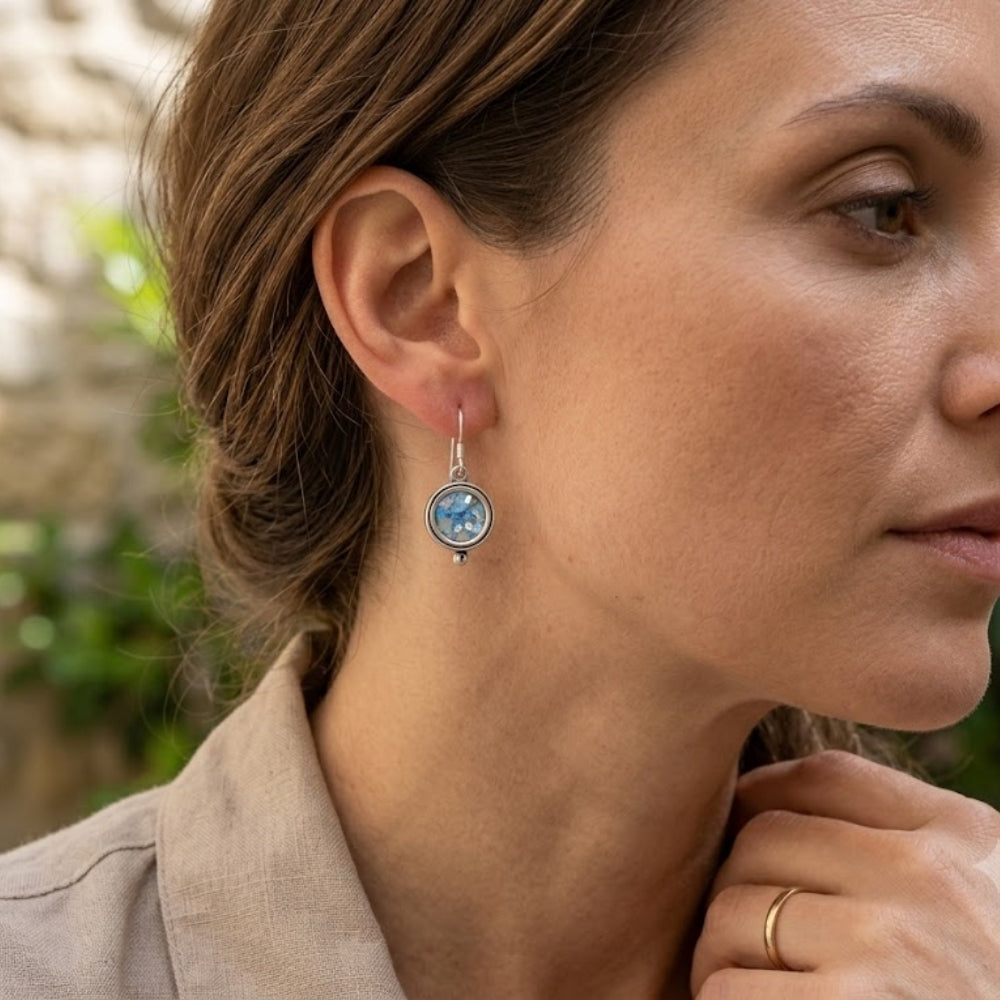
Roman glass jewelry uses fragments of ancient glass, often recovered from archaeological contexts in Israel and the surrounding region, as decorative elements in modern settings. The attraction is not only the age of the material. Weathered glass can develop luminous blue, green, aqua, violet and gold surfaces that look almost metallic or opalescent, giving every fragment a different pattern.
For shoppers, the phrase Roman glass necklace can cover a wide range of products: a small glass shard framed in sterling silver, a polished geometric insert, a larger irregular fragment, or a piece combined with Hebrew and Jerusalem motifs. Baltinester's Roman glass jewelry collection is divided into necklaces, pendants, rings, bracelets and earrings, which makes it easier to compare how the material behaves in different settings.
Why the glass becomes iridescent
The colorful surface is the result of long-term chemical weathering. Ancient glass buried in soil can react with moisture and minerals over centuries. Thin layers at the surface gradually change, and light reflecting through those layers can produce the rainbow-like appearance collectors value. The colors are therefore linked to age and environment rather than being the same thing as a modern painted coating.
That surface can also be fragile. Iridescent layers may flake if they are scrubbed aggressively or exposed repeatedly to water and chemicals. This is why Roman glass care is different from caring for a plain gold pendant or a hard gemstone. Preservation should take priority over trying to make the glass look polished.
Is all "Roman glass" actually Roman?
Buyers should ask what the seller means by the term. "Roman glass" is widely used in the jewelry market, but a product page should provide a reasonable provenance statement rather than asking the customer to rely on color alone. Iridescence by itself is not proof of antiquity; modern glass can also be treated or coated to create colorful effects.
Look for a seller that identifies the material clearly, explains how the fragments were sourced and complies with applicable antiquities rules. If a certificate or provenance documentation is offered, read what it actually certifies. The strongest trust signal is specific, consistent information across the product page, packaging and customer service - not a dramatic claim that cannot be verified.

Why Israel is associated with Roman glass jewelry
The Roman and Byzantine periods left extensive glass remains across the region, and ancient fragments have long appeared in archaeological contexts. Israeli jewelers developed a distinctive modern style of setting these fragments in silver and gold, often pairing them with Jewish symbols, Jerusalem imagery or contemporary geometric frames.
That combination gives the jewelry two stories at once: the ancient material and the modern Israeli craft. A Roman glass necklace can therefore appeal to someone interested in archaeology, Israel, color or simply one-of-a-kind texture. Because no two weathered fragments look exactly the same, variation should be expected rather than treated as a defect.
How to care for Roman glass jewelry
Keep Roman glass dry. Remove it before showering, swimming, exercising heavily or washing dishes. Avoid perfume, hairspray, cleaning products and ultrasonic jewelry cleaners. Do not scrub the glass with a polishing cloth designed for metal because the pressure can disturb the delicate surface layers.
After wear, wipe the surrounding metal gently with a soft dry cloth without rubbing the glass itself. Store the piece separately so harder jewelry cannot scratch or chip it. For a ring, be even more careful: hands encounter water, soap and impacts throughout the day. A Roman glass ring is better treated as special jewelry than as a piece to wear through every household task.
Gold versus silver settings
Sterling silver is common because its cool tone complements blue-green iridescence and allows larger pieces to remain relatively accessible. Gold creates a warmer contrast and can make the same fragment feel more formal. Neither metal makes the glass itself more durable, so the setting should be evaluated for how well it protects the edges of the fragment.
Bezel-like frames and recessed settings can provide more protection than a fragment that projects far above the metal. For earrings and pendants, impact risk is lower than on rings and bracelets. Choose the jewelry type based not only on appearance but also on the wearer's routine.

What to expect from color and variation
Ancient glass is not standardized. Product photographs may show a particular balance of turquoise, green or gold that cannot be reproduced exactly in every fragment. Before buying, check whether the piece shown is the exact item you will receive or a representative sample. If variation matters to you, ask the seller how closely your piece will match the photos.
This natural variation is part of the appeal. The best Roman glass jewelry does not try to make the material look machine-perfect. It frames the irregularity so the ancient surface remains the focal point while the modern metalwork gives the fragment structure and wearability.
A better way to shop for Roman glass
Choose the seller before you choose the color. Look for clear material descriptions, realistic care instructions, visible dimensions, metal specifications and a straightforward explanation of provenance. Then decide which format fits the wearer: necklace for easy everyday visibility, earrings for lighter wear, or a ring for a more tactile statement.
For a gift connected to Israel, Roman glass jewelry has an advantage over generic souvenirs: the material story is specific and the modern craftsmanship can be evaluated like any other piece of fine jewelry. A thoughtful description should help the buyer appreciate both parts of that story without romanticizing what cannot be documented.
Frequently Asked Questions
Can Roman glass jewelry get wet?
It is best to keep Roman glass dry. Repeated exposure to water, soap and chemicals can damage fragile weathered surface layers.
Why is Roman glass blue or iridescent?
Long-term weathering can create thin altered layers on ancient glass. Light interacting with those layers produces the colorful iridescent appearance.
How can I tell whether Roman glass is authentic?
Color alone is not enough. Buy from a reputable seller that provides clear provenance information, material descriptions and documentation where applicable.


